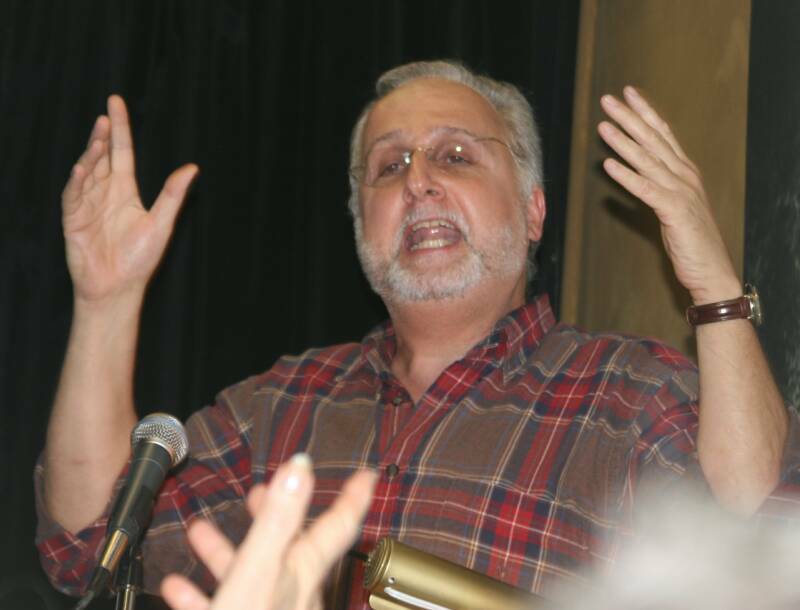
The Humanities and Sciences Department held its annual symposium on November 16. This year’s event “Voices in War: The Artist’s Perspective,” brought together three members of the SVA Community who related their experiences in the military during the Iraq War and described the impact it has had on their artwork.
 SVA faculty member Dr. Camillo “Mac” Bica organized and moderated the symposium. Dr. Bica is a veteran of the Vietnam War and a longtime advocate for veteran’s rights, peace, and social justice. Panelist’s included Petty Officer Brian Nielson, United States Navy, a current SVA student (Computer Art); Corporal James Martin, United States Marine Corps Reserve (BFA, 2006) and Major Peter Buotte, United States Army Reserve (BFA, 1999). A packed house of faculty, staff, students, veterans, and guests shared a straightforward, highly personal commentary on the war, its effect on the men’s lives and how their art was influenced by the experience.
The goal of the event was not to present any particular opinion about the Iraq War – the panelists were not asked beforehand about their point of view – but to motivate artists to become socially engaged, to become activists. As Dr. Bica pointed out, it used to be the responsibility of journalists to objectively investigate, analyze, and report about wars, but there is no Edward R. Murrow reporting from Iraq so it has been left to artists to fill in and show the true nature of war, to make the public feel and question.
Petty Officer Brian Nielson joined the Navy at the age of twenty and was working essentially a 9-5 job as a hospital corpsman at Bethesda Naval Medical Center. On 9/11, the Hospital got patient load from the attack on the Pentagon. Despite the isolation of six to seven month stints on base, he noted that he laughed moiré in the military than
One effect of the isolation is to reinforce the solidarity of the team. Nielson noted that soldiers fight, not for the American citizenry, but for each other. Thus the war has to have positive purpose; else his brothers fell for nothing. Perhaps, that is why those returning talk about building schools and hospitals rather than killing.
In his art, he tries to combine his favorite art form, graffiti, a “voice for the voiceless,” with effects. Among the works he showed was an image of five soldiers in silhouette above the stenciled word “Beans.” The image resembled a box of supplies. Soldiers, Nielson explained, are counted like beans, identified by social security number rather than a human beings. He also showed a Warhol-reminiscent image of three identical grenades, a motif that appears frequently in his work.
James Martin joined the Marines on Thanksgiving 2001 after watching from Brooklyn Heights as the Towers fell on 9/11. He was stationed in “one of those places in Iraq you never hear of; like a beach with no water.” Despite mortar rounds coming in almost daily, it was the most monotonous and boring thing he had ever done. As Martin